
Designing A Food Systems Strategy
How Hawaii’s food and agriculture organizations can articulate and develop a strategy based on where they fit, what they do differently, and why it matters.
A Food Systems Strategy is a framework that helps a food or agriculture organization define its role in the regional food system, sharpen what it uniquely does, and prove the impact of its work. This resource outlines the full framework built from Jong Enterprise’s research across Hawaii’s food ecosystem to show how organizations can apply this strategic framework to make better, data-driven decisions.
Why Do Organizations Need A Food Systems Strategy?
Three conditions across Hawaii’s food sector make strategic clarity a must within food and agriculture organizations.
Most food system organizations operate with unstable revenue and funding. Through stakeholder conversations, we’re able to get an inside look at the organizations building Hawaii’s food system. Many rely on grant funding, community donations, private capital, and have a turbulent balance sheet.
Multiple organizations across Hawaii’s food sector serve the same demographic. With a wide variety of organizations providing similar value propositions, it’s essential to properly outline an organizations’ position within the broader food system.
Without a systems view, organizations make strategic decisions with only a partial picture of the sector. Many organizations operate within their own individual functions without having a picture of the food system as a whole.
The Funding Environment Has Made This Urgent
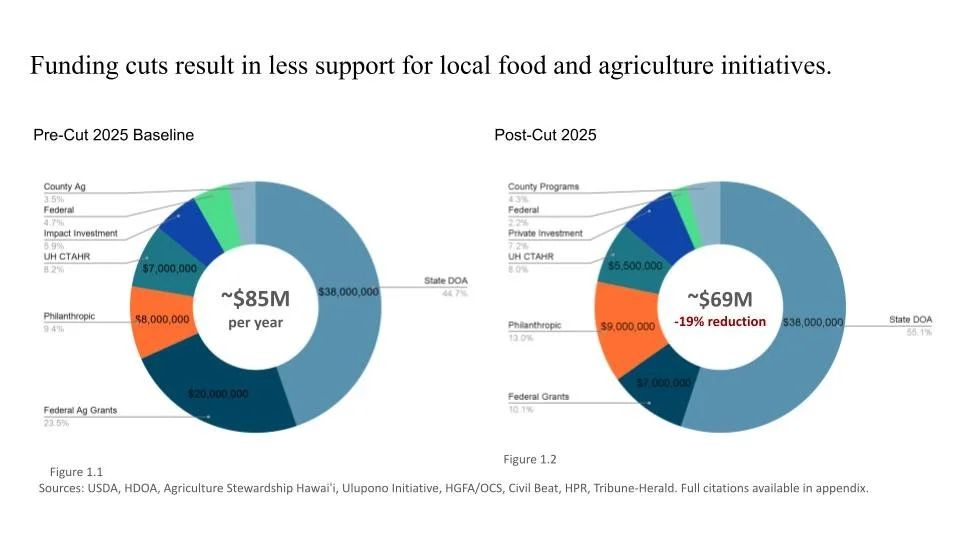
Federal agriculture grants fell from $20M to $7M. A 65% cut to the largest single funding source for food systems infrastructure in Hawaii create a large financial gap for the sector. Various research and development programs were cancelled, government programs were frozen, and micro-grants were reduced.
The State Department of Agriculture’s share rose from 44.7% to 55.1% of all capital. This isn’t because the state budget grew but rather because everything else shrank around it. When one source represents more than half of all capital flows, the sector doesn’t have a funding strategy. It has more of a dependency instead.
Philanthropic funding grew from $8M to $9M. This was the only financial category that increased as foundations began to backfill gaps from federal cuts. However, a $1M increase against a $16M federal loss means that philanthropy is absorbing less than 7% of the given shortfall. This presents a weakness and opportunity for philanthropic organizations and the sector as a whole.
The Current Landscape of Hawaii’s Food Ecosystem
Funding cuts have resulted in less support for local food and agriculture initiatives. Annual capital flowing to Hawaii’s food organizations fell from approximately $85 million to approximately $69 million after the 2025 cuts; a 19% reduction. However, the sector didn’t just lose funding; it lost diversification of financial assets.
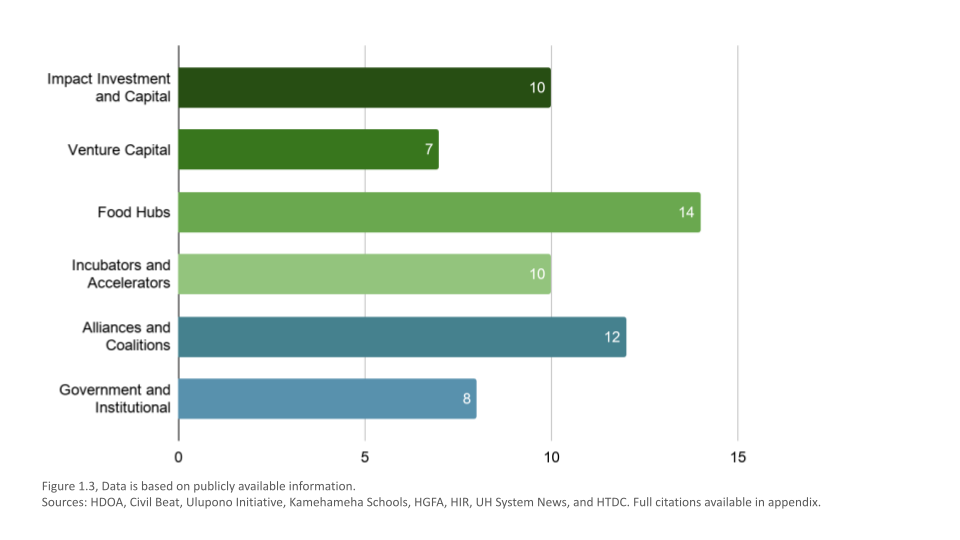
There are approximately 61 organizations serving Hawaii’s food system, spanning impact investment firms, venture capital, food hubs, incubators and accelerators, alliances and coalitions, and government and institutional actors.
Through direct engagement with stakeholders across the industry, we’ve identified organizational overland and structural fragmentation as two of the biggest driving factors toward a disconnected food system.
A Food Systems Strategy gives an organization the clarity to identify where it fits, where it doesn’t, and how to build an operational model that turns a mission into measured impact on the community and broader food system. The following organizations benefit most from a food systems strategy:
Intermediaries: Food hubs, distributors, and industry aggregators that connect local producers to markets and carry multiple stakeholder expectations.
Non-profits: Mission-driven organizations working in food access, agricultural development, food security, and community health.
Accelerators and incubators: Program development for new and existing food and agriculture ventures through cohorts, technical assistance, and capital access.
By utilizing these frameworks to rebuild programs and develop new ventures around tighter funding, defended budgets, and a clear value proposition from peers, Hawaii-based food organizations can clearly identify where they fit in the regional food system and how they uniquely contribute to the sector.
What does a Food Systems Strategy Look Like?
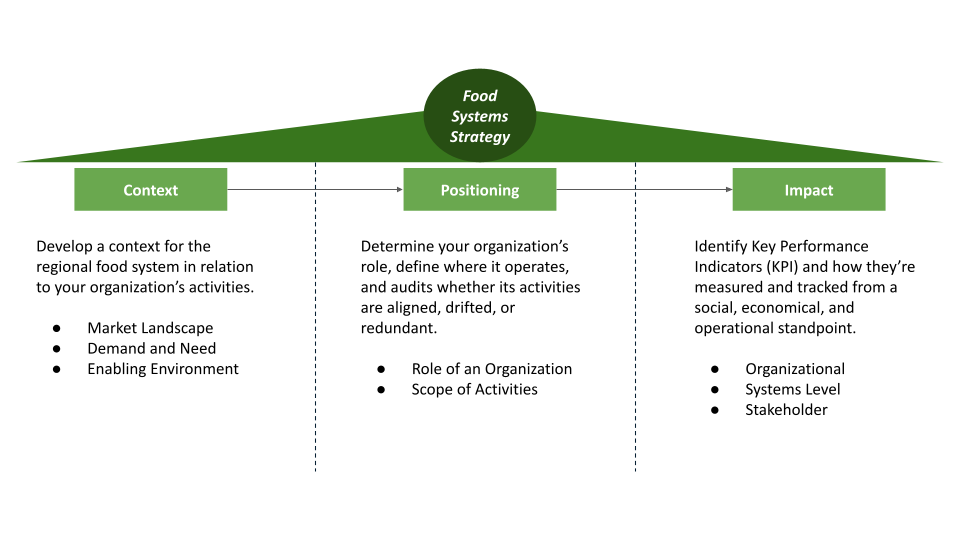
A Food Systems Strategy is built on three primary components:
1. Building a Systems Level Context
Understanding the broader food system from an organizational perspective is essential for building a strategy that accounts for all of the variables in the environment it has to succeed in. System-based context is a focused assessment of the information an organization needs in order to make strategic decisions. Three categories of information shape the context of an organizations role in the broader food system.
Market Landscape
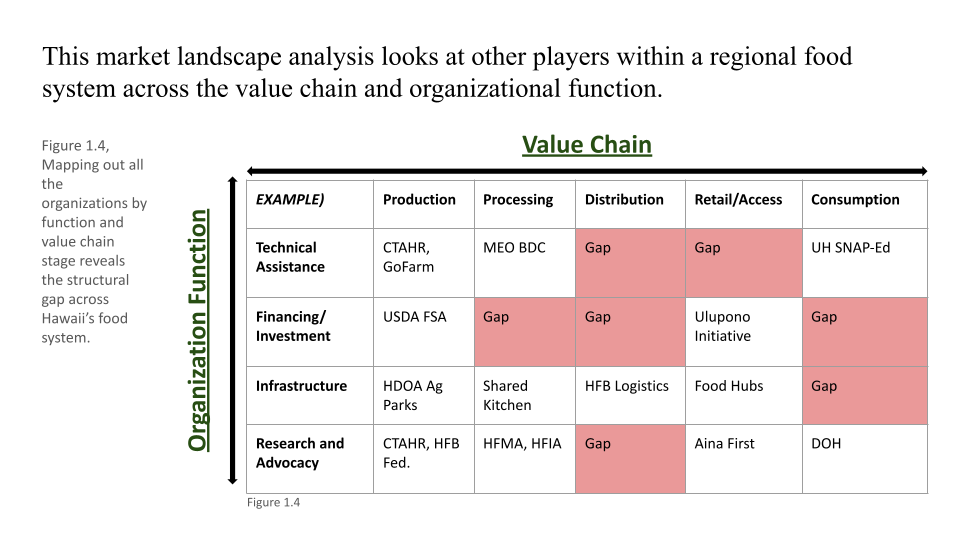
The market landscape analyzes an organization’s current position in the regional food system and how its operations fit in the ecosystem. A thorough market landscape analysis maps other players in the regional food system across two dimensions: value chain stage and organizational function.
Mapping all the organizations within Hawaii’s food ecosystem by function and value chain reveals the structural gaps across Hawaii’s food system. For example, technical assistance is concentrated at the production stage but gaps exist across distribution and retail. Financing shows gaps at processing, distribution, and consumption. Infrastructure gaps appear at the consumption stage.
Mapping all the organizations within Hawaii’s food ecosystem by function and value chain reveals the structural gaps across Hawaii’s food system. For example, technical assistance is concentrated at the production stage but gaps exist across distribution and retail. Financing shows gaps at processing, distribution, and consumption. Infrastructure gaps appear at the consumption stage.
Demand and Need
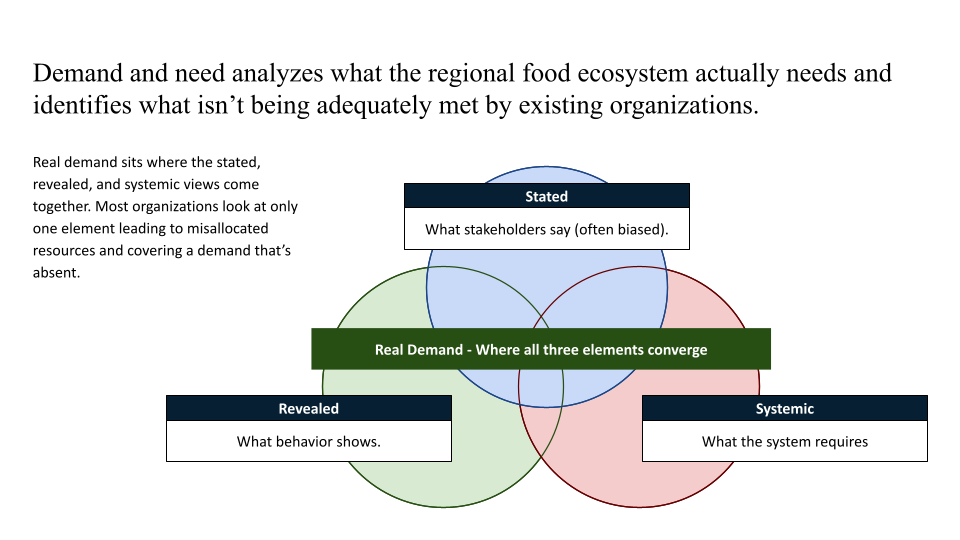
Demand and need analyzes what the regional food ecosystem actually needs and identifies what isn’t being adequately met by existing organizations. There are three different types of demand that organizations need to look for:
Stated Demand: What stakeholders say they need.
Revealed Demand: What do the behaviors of the market say they need.
Systemic Demand: What does the system need.
Real demand sits where the stated, revealed, and systemic views come together. Most organizations look at only one of these elements which leads to misallocated resources and programs that are built to cover a demand that’s absent or not fully defined.
Enabling Environments
The enabling environment analyzes the external forces shaping what’s possible, what’s viable, and what’s sustainable in a regional food system. Five variable determine this:
Funding and Capital: This determines where resources flow and which initiatives scale. A sustainable system requires diversified, aligned capital that reduces dependency on single funding sources and supports long-term viability.
Policy: Sets the rules, incentives, and constraints that shape system behavior. Sustainability depends on coordinated, forward-looking policy that enables investment, infrastructure, and equitable access.
Economics: Defines market viability though pricing, demand, and cost structures. A sustainable system requires economically viable models that can operate without continuous capital injection.
Infrastructure: Provides the physical and logistical support for the system. There needs to be adequate, coordinated infrastructure capacity to prevent bottlenecks and allow efficient flow across the value chain.
Culture and Social: Shapes adoption, trust, and behavior within the food system. Strategies need to reflect community values while driving participation.
2. Strategic Positioning
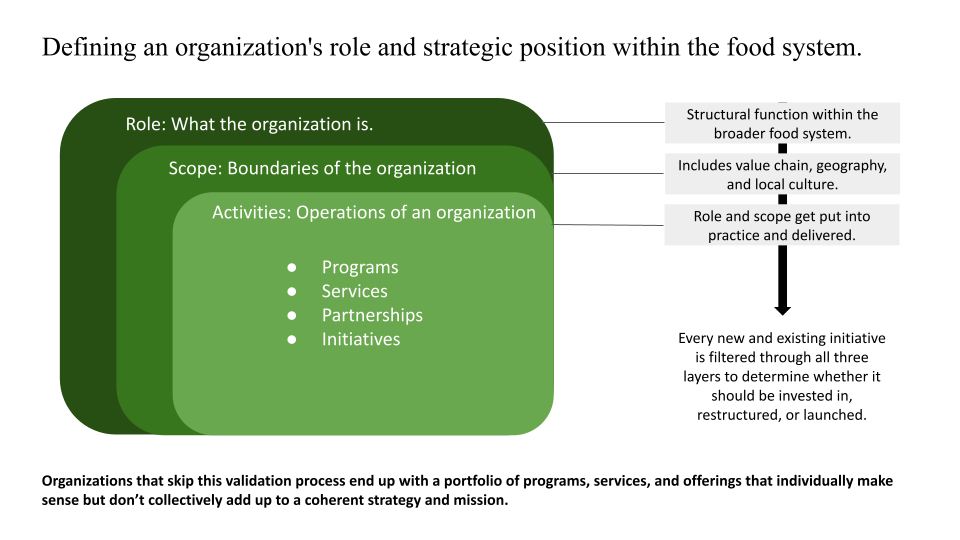
By analyzing their activities and role in the broader food system, organizations are able to make informed decisions based on data-driven insights. Strategic positioning for a food systems strategy consists of three layers:
Role: Looks at what the organization actually is and it’s structural function within the broader food system.
Scope: What are the boundaries of the organization in regards to value chain coverage, geographic location, and local culture.
Activities: The operations of the organization where role and scope get put into practice and delivered; programs, services, partnerships, and initiatives.
Every new and existing initiative is filtered through all three layers to determine whether it should be invested in, restructured, or launched. Organizations that skip this validation process end up with a portfolio of programs, services, and offerings that individually makes sense but don’t collectively add up to a coherent strategy and mission.
3. Measuring Impact
By building the data infrastructure and benchmarks to analyze outputs and outcomes, organizations are able to prove their impact to funders, partners, stakeholders, and themselves. There are three levels of returns on a Food Systems Strategy:
Organizational: Measures whether the strategy made the organization stronger, more focused, more fundable, and more resilient.
Systems Level: Looks at whether the regional food system actually improves as a result of the organization’s intentionality and activities.
Stakeholder: Analyzes whether the strategy created tangible impact in the communities and people it serves.
Very few organizations can measure the impact they had on the food system. Tracking activity is for funders and social proof, tracking impact is for making strategic decisions within the organizations. When it comes to putting this type of measurement into practice, there are two layers that are crucial to design:
Data Infrastructure: Organizations need to determine what kind of data infrastructure they want to build to track impact. Developing collection methods, baseline metrics, and longitudinal tracking will allow them to demonstrate impact in an effective way.
Benchmarking and Analysis: Developing benchmarking tools provide a starting point for analysis and supply the Key Performance Indicators (KPI) for developing impactful programs.
By measuring impact paired with effective data infrastructure and benchmarking and analysis, organizations will be able to translate operations and activities into community and systems-level impact.