Building Hawaii's Food Workforce: A Pathway to Food Security and Economic Resilience
Download the PDF | Share the article | Subscribe to the series
Authors:
Jesse Jong: Managing Partner at Jong Enterprise
Alexis Chapman: Director of Operations at Hawaii Food Industry Association
Hawaii’s food system workforce faces a range of challenges including two urgent priorities:
Strengthening the state's food security and,
Improving economic opportunities for local residents and businesses.
This article explores how workforce modernization can help Hawaii develop a more productive and technically skilled workforce while strengthening food security and economic resilience.
Hawaii has the highest cost of living amongst all 50 states which heavily impacts workforce recruitment and retention. In the 2026 Hawaii Food Industry Report, 63% of food manufacturers and 40% of food producers report labor shortages and workforce retention as their largest operational challenges. By addressing the root causes of workforce retention challenges and economic conditions in the food sector, local businesses and organizations can build a more skilled and stable talent pool, enabling growth while strengthening Hawaii’s economy and food systems resilience.
Hawaii’s food sector faces a workforce attraction and retention problem
Based on interviews and conversations with local leaders and business owners, we’re able to identify workforce attraction and retention as a key issue that organizations have to deal with on a regular basis. Many roles within the food sector are labor-intensive, offer limited career progression, and provide fewer opportunities to develop transferable technical skills. Research by the OECD identifies low wages, limited career prospects, and negative perceptions of agriculture as the key contributors to the labor and skills shortages across food systems. In Hawaii, workforce challenges are further compounded by an aging producer population and workforce housing barriers which make it difficult to attract and retain workers in food and agricultural communities. Put together, these conditions make food-sector careers less attractive for prospective employees relative to opportunities in other industries. This leads to an imbalance between workforce demand and labor supply, creating recruitment and retention challenges for businesses across Hawaii’s food system. Because the underlying constraints surrounding the workforce are structural and slow to change, addressing the gap through recruitment and attraction alone is unlikely to be sufficient. Organizations need a second lever: increasing the output and skill ceiling of the existing workforce.
Technology and modernization of operations can increase workforce productivity, food security, and economic resilience
Based on the 2026 Hawaii Food Industry Report, workforce growth alone may not be sufficient to meet the future needs of Hawaii’s food system. The modernization of food-based operations through the use of technology represents another pillar to improve productivity for local businesses while creating opportunities for employees to develop technical and transferable skills. By creating these opportunities, organizations can focus more on oversight, quality assurance, analysis, and management. Digital tools, automation, and data-driven management systems can help reduce the time spent on repetitive, administrative, and operational tasks, and instead allow employees to focus on higher-value activities such as quality assurance, planning, analysis, and management. Given that 57% of local producers reported using no technologies in their operations, modernization through technology and efficiencies represent a significant opportunity to improve workforce productivity and operational efficiency across Hawaii’s food system. Improved workforce productivity allows local businesses to expand production, operate more efficiently, and strengthen long-term growth. At a state level, these productivity gains can support greater local food production capacity, contribute to improved food security, and help build economic resilience throughout Hawaii’s food system. Meanwhile, a technically empowered workforce can drive organizational and economic growth for the value chain as a whole.
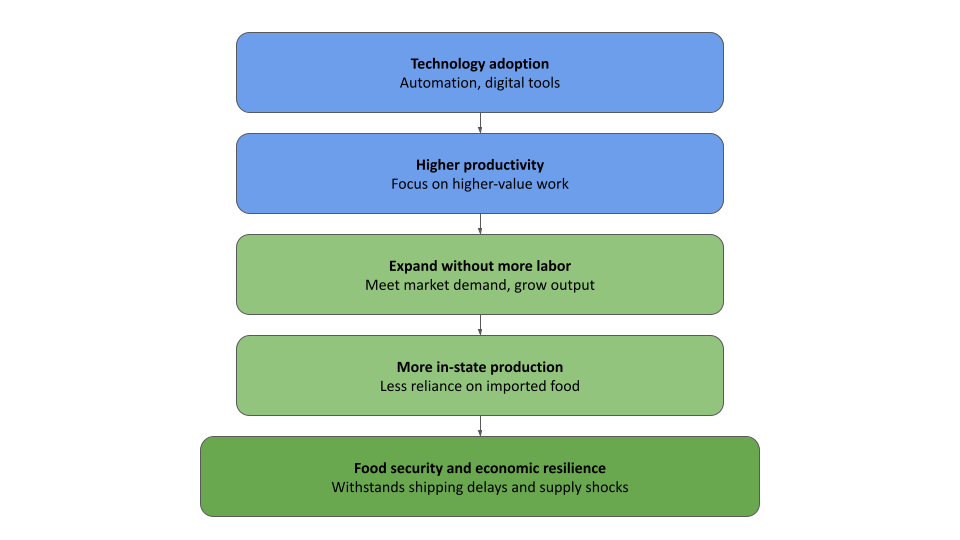
The modernization of the food ecosystems workforce also strengthens the food security and economic resilience of Hawaii by enabling food-based businesses and organizations to operate more efficiently and at a greater scale. Through the adoption of technology, automation, training, and modern management practices, employees can become more productive and focus on higher-value and highly technical activities. This increased productivity allows businesses to expand without needing an increase in labor which helps them meet growing demand and improve profitability. As more local food businesses increase production capacity, Hawaii is able to supply a larger portion of local food demand through in-state production leading to reduced vulnerability to disruptions in imported food supply chains. With the modernization of the workforce, a more robust and self-sufficient food system is better positioned to withstand external disruptions, such as shipping delays, supply shortages, and economic shocks, and ultimately improves both food security and long-term economic resilience across the state.
Conclusion
Strengthening Hawaii’s food workforce isn’t just a labor issue, it’s a critical component in building the state’s food security and economic resilience. As labor shortages and complications continue to challenge food businesses across the state, workforce growth isn’t going to be enough to meet the future needs of Hawaii’s food system. Strategic investments into workforce modernization, technical skills development, and higher-quality career pathways can help businesses attract and retain talent while improving productivity and capacity. A more productive and technically skilled workforce enables food-based businesses and organizations to focus on higher-value activities, expand production, improve competitiveness, and increase local food capacity. As Hawaii works to reduce its dependence on imported foods and strengthen the resilience of its food system, workforce modernization represents one of the most practical pathways toward achieving these goals. The organizations that invest into their workforce today will be better positioned to support future growth, contribute to a stronger local food ecosystem, and help build a more sustainable, resilient, and self-reliant food economy for Hawaii.
Frequently Asked Questions
Why does Hawaii’s food industry face labor shortages?: Hawaii has the highest cost of living in the nation, paired with the aging producer population and workforce housing barriers, food-sector jobs become hard to fill. In the first 2026 survey, 63% of food manufacturers and 40% of producers cited labor shortages as their biggest operational challenge.
What is workforce modernization?: Workforce modernization is the act of adopting technology, automation, and modern management practices so that employees can shift from repetitive manual tasks to higher-value work like quality assurance, analysis, and management. Workforce modernization promotes innovation and creativity across all roles.
Can Hawaii solve its food workforce problem through recruitment alone?: No, the constraints surrounding Hawaii’s food workforce challenges are structural and slow to change; hiring alone wont close the gap. Businesses need to raise the productivity and skill ceiling of their existing workforce while also increasing recruitment.
How does technology improve food workforce productivity?: Digital tools and automation cut the amount of time spent on repetitive tasks. This lets businesses expand their output without adding additional labor. With 57% of local producers utilizing no technology, the room for gains is significant.
How is workforce modernization connected to food security?: More productive local businesses can supply a larger share of Hawaii’s own food demand which reduces reliance on imports. That makes the food system more resilient to shipping delays, shortages, and economic shocks.